Every Toronto homeowner wonders at some point: how long does a roof last? The answer depends on the roofing material, installation quality, maintenance history, and the specific challenges of Toronto’s climate — which is among the most demanding in North America for roofing systems. Understanding the expected lifespan of your roof by material type, the factors that shorten or extend that lifespan, and the maintenance strategies that maximize your roofing investment helps Toronto homeowners plan proactively for repair and replacement rather than reacting to emergency failures. The Roof Technician has inspected and replaced thousands of roofs across Toronto and the GTA — the patterns of premature failure and extended longevity we observe align closely with the data in this guide.
Roof Lifespan by Material in Toronto
The following table represents realistic roof lifespan ranges for Toronto’s climate specifically — not the manufacturer’s ideal-conditions warranty, but what Toronto homeowners actually experience given our freeze-thaw cycles, ice loading, UV exposure, and severe storm frequency.
| Roofing Material | Expected Lifespan in Toronto | Manufacturer Warranty | Installed Cost per Sq Ft | Lifetime Cost per Year |
|---|---|---|---|---|
| 3-tab asphalt shingles | 12-18 years | 20-25 years | $4-$7 | $0.35-$0.50/yr |
| Architectural asphalt shingles | 18-25 years | 30-50 years (limited lifetime) | $5-$10 | $0.30-$0.45/yr |
| Premium/designer asphalt shingles | 20-30 years | 50 years – limited lifetime | $7-$14 | $0.35-$0.55/yr |
| Cedar shakes | 25-40 years | N/A (natural material) | $12-$22 | $0.45-$0.70/yr |
| Metal standing seam (steel) | 40-60 years | 40-50 years | $12-$18 | $0.25-$0.35/yr |
| Metal standing seam (aluminum) | 50-70 years | 40-50 years | $14-$22 | $0.25-$0.35/yr |
| Clay or concrete tile | 40-60 years | 50-75 years | $15-$30 | $0.35-$0.55/yr |
| Slate | 60-100+ years | 75-100+ years | $25-$50 | $0.30-$0.50/yr |
| TPO/EPDM flat roof | 15-25 years | 15-25 years | $6-$12 | $0.35-$0.55/yr |
| Modified bitumen flat roof | 15-25 years | 15-20 years | $5-$10 | $0.30-$0.50/yr |
| Copper | 80-100+ years | Indefinite | $25-$45 | $0.30-$0.45/yr |
Notice that when calculated on a lifetime cost per year basis, the most expensive upfront materials (metal, slate) are actually among the most economical long-term choices — because their extraordinary lifespan spreads the cost over many more years. A standing seam metal roof at $15/sq ft lasting 50 years costs $0.30 per square foot per year, while a 3-tab asphalt roof at $5/sq ft lasting 15 years costs $0.33 per square foot per year — essentially the same annual cost despite the metal roof being 3x more expensive upfront.
Toronto Climate Factors That Affect Roof Lifespan
Toronto’s climate presents a uniquely challenging environment for roofing materials. The following factors explain why roofs in Toronto often fail earlier than the manufacturer’s warranty suggests.
| Climate Factor | Impact on Roof Lifespan | Most Affected Materials |
|---|---|---|
| Freeze-thaw cycles (100+/winter) | Repeated expansion/contraction causes cracking, splitting, granule loss | Asphalt shingles, cedar shakes, concrete tile |
| Ice dam formation | Ice forces water under shingles, damaging underlayment and sheathing | All materials — especially asphalt without proper ice shield |
| Heavy snow loads | Weight stress on structure, moisture from snowmelt at eaves | All materials — flat roofs especially vulnerable |
| UV exposure (hot summers) | Degrades asphalt binders, dries cedar oils, fades coatings | Asphalt shingles (south/west slopes), cedar shakes |
| Severe storms (wind, hail) | Shingle blow-off, hail cracking, tree impact | 3-tab shingles (worst wind resistance), cedar shakes |
| Temperature extremes (-30 to +35°C) | 65°C annual range causes thermal fatigue in all materials | All materials — metal expansion/contraction, asphalt brittleness |
Signs Your Roof Is Approaching End of Life
Recognizing the warning signs of a roof nearing the end of its lifespan allows Toronto homeowners to plan a proactive roof replacement rather than dealing with emergency failure during a storm. Here are the key indicators.
- Age approaching expected lifespan: If your asphalt shingle roof is 18-22 years old, or your 3-tab roof is 12-15 years old, proactive replacement planning should begin
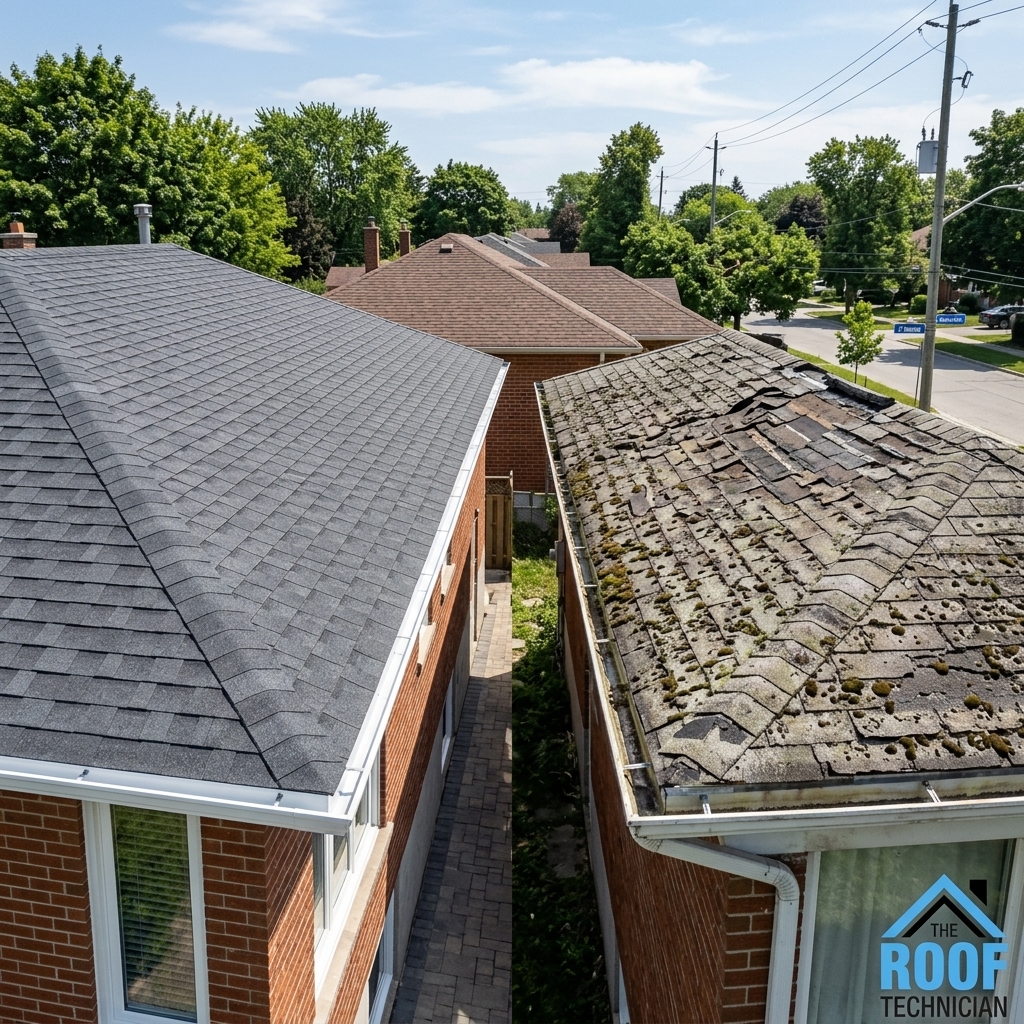
- Excessive granule loss: Finding significant granules in gutters and downspout outlets means the asphalt shingles have lost their protective surface — UV damage will accelerate rapidly from this point
- Widespread curling or cupping: When shingles curl at edges (clawing) or cup in the centre, they have lost adhesive bond and are highly vulnerable to wind uplift
- Cracked or brittle shingles: Shingles that crack when touched or flexed have become thermally fatigued — they will not survive another Toronto winter
- Missing shingles after every storm: If you are losing shingles with every moderate wind event, the adhesive seal strip has failed across the roof
- Daylight visible from attic: Light penetrating through the roof deck into the attic indicates gaps or holes that are allowing water entry
- Sagging roof plane: Any visible dipping or sagging in the roof surface indicates structural issues — either the sheathing has deteriorated or the framing is compromised. This requires immediate professional assessment from The Roof Technician
- Multiple active leaks: A single leak can be repaired. Multiple leaks in different locations indicate systemic roof failure
- Moss and algae covering large areas: While moss itself does not end a roof’s lifespan, widespread moss growth on asphalt shingles accelerates granule loss and moisture retention
How to Extend Your Roof’s Lifespan in Toronto
Proper maintenance can add 5-10 years to your roof’s effective lifespan in Toronto’s climate — a significant return on relatively modest maintenance investments.
- Annual professional inspection: Have The Roof Technician inspect your roof every spring. Early detection of cracked flashings, lifted shingles, blocked vents, and minor damage prevents small problems from becoming major failures. Cost: $200-$400/year
- Keep gutters clean: Clogged gutters cause water to back up under the drip edge and behind the fascia — accelerating rot and water damage at the most vulnerable edge of the roof system. Clean gutters twice yearly (fall and spring)
- Maintain proper attic ventilation: Inadequate attic ventilation causes heat buildup that bakes shingles from underneath (reducing lifespan by 15-25%), promotes ice dam formation, and traps moisture that deteriorates sheathing
- Trim overhanging branches: Branches rubbing on shingles abrade the surface. Overhanging trees drop debris that traps moisture and promotes moss growth. Maintain 6-8 feet of clearance between branches and the roof surface
- Address repairs promptly: A small roof repair ($200-$500) prevents water intrusion that can cause thousands in secondary damage and accelerate the deterioration of surrounding roofing materials
- Ensure proper insulation: Adequate attic floor insulation (R-60 recommended for Ontario) keeps the roof surface cold and uniform, preventing the snowmelt-refreeze cycle that creates ice dams
Roof Lifespan and Home Insurance in Toronto
The age and condition of your roof directly affects your home insurance policy in Toronto — and understanding this relationship is important for homeowners approaching the expected end of their roof’s lifespan. Ontario home insurance companies increasingly factor roof age into their underwriting decisions. Many insurers will not issue new policies for homes with roofs older than 20 years without a professional inspection confirming the roof is in acceptable condition. Some insurers apply higher deductibles for roof claims on homes with roofs older than 15 years. And Actual Cash Value (ACV) depreciation means that an insurance claim on an older roof may pay out significantly less than the full replacement cost — a 20-year-old roof on a 25-year shingle may receive only 20% of the replacement value under an ACV policy.
Proactively replacing your roof before it fails — rather than waiting for emergency failure — provides several insurance advantages. A new roof qualifies for the lowest insurance premiums and deductibles. Replacement Cost Value (RCV) policies provide full replacement coverage without depreciation for roofs in the first 10-15 years. And documented maintenance and proactive replacement demonstrate responsible homeownership that insurers reward with preferred rates. The Roof Technician provides roof condition reports that homeowners can share with their insurance brokers to demonstrate the current condition and remaining lifespan of their roof system.
When Roof Repair Is Smarter Than Replacement
Not every aging roof needs immediate replacement. In many cases, targeted roof repairs can extend the functional lifespan of your Toronto roof by 3-7 years — buying time to budget for a full replacement or align the replacement with other planned renovations. Repairs are the smarter choice when the roof is less than 75% through its expected lifespan (e.g., a 15-year-old architectural shingle roof), damage is localized to specific areas rather than systemic across the entire roof, the underlying sheathing and structure are in good condition with no rot or sagging, and the cost of repair is less than 30% of the full replacement cost. However, repairs become a poor investment when the roof has exceeded 80% of its expected lifespan, when multiple areas show simultaneous deterioration, when the sheathing requires repair in multiple locations, or when the repair cost approaches 40-50% of a full replacement. The Roof Technician provides honest assessments that recommend the most cost-effective approach — whether repair or replacement — based on the specific condition and remaining lifespan of your Toronto roof.
Roof Maintenance Checklist for Maximum Lifespan
Following this annual maintenance checklist helps Toronto homeowners maximize their roof’s lifespan regardless of material type. In spring: schedule a professional roof inspection, check for winter ice dam damage, inspect flashing at all penetrations, clean gutters of winter debris, and verify attic ventilation is unobstructed. In summer: inspect for storm damage after severe weather events, check for moss or algae growth on north-facing slopes, trim branches within 6 feet of the roof surface, and verify all roof vents are clear. In fall: clean gutters thoroughly before winter, check for lifted or damaged shingles before freeze-thaw begins, verify attic insulation levels (R-60 recommended), and inspect soffit vents for blockage by blown insulation. In winter: monitor for ice dam formation, remove heavy snow accumulation from flat roofs (over 4 feet), watch for condensation or frost buildup in the attic, and address any active leaks immediately with emergency tarping.
How long does an asphalt shingle roof last in Toronto?
How long does a metal roof last in Toronto?
What shortens a roof’s lifespan in Toronto?
When should I replace my roof in Toronto?
Does a flat roof last as long as a sloped roof?
How can I make my roof last longer?
Know Your Roof’s Lifespan — Call The Roof Technician
The Roof Technician provides expert roof inspections, lifespan assessments, and roof replacement services across Toronto, Mississauga, Brampton, Oakville, Burlington, Vaughan, Markham, and the full GTA. We help Toronto homeowners understand exactly where their roof is in its lifespan and plan proactively for the future.
Call (416) 826-0040 or request a free roof assessment.
The Roof Technician — Toronto’s trusted roofing contractor for roof replacement, roof repair, flat roofing, and attic ventilation across the GTA.