If you live in Toronto and have a skylight, you already know the mid-summer struggle: the same feature that floods your home with beautiful natural light in April becomes a solar furnace by the time June arrives. Skylight shades summer heat toronto management is one of the most searched roofing-adjacent topics in the GTA right now, and for good reason — the right shade can cut solar heat gain by more than 70 percent, slash your air-conditioning costs, and protect your furniture and flooring from UV damage, all without blocking the natural light you installed the skylight for in the first place. This guide covers every shade type on the Canadian market, what they cost installed, how to choose the right option for your specific skylight, and when it makes sense to call a professional.
At The Roof Technician, we field dozens of calls every summer from homeowners in Toronto, Mississauga, Markham, Vaughan, and Brampton who are surprised to discover that their skylight has become the primary driver of indoor heat. The good news is that the solution is almost always straightforward, cost-effective, and achievable within a single summer season. Read on for everything you need to know about skylight shades summer heat toronto control in 2026.
Whether your skylight is a fixed unit, a venting model, a flat-roof curb-mounted light, or a tubular sun tunnel, there is a shade system designed specifically for it. Understanding the differences — in fabric technology, mounting style, light-filtering capacity, and price — is the first step to making the right investment for your home.
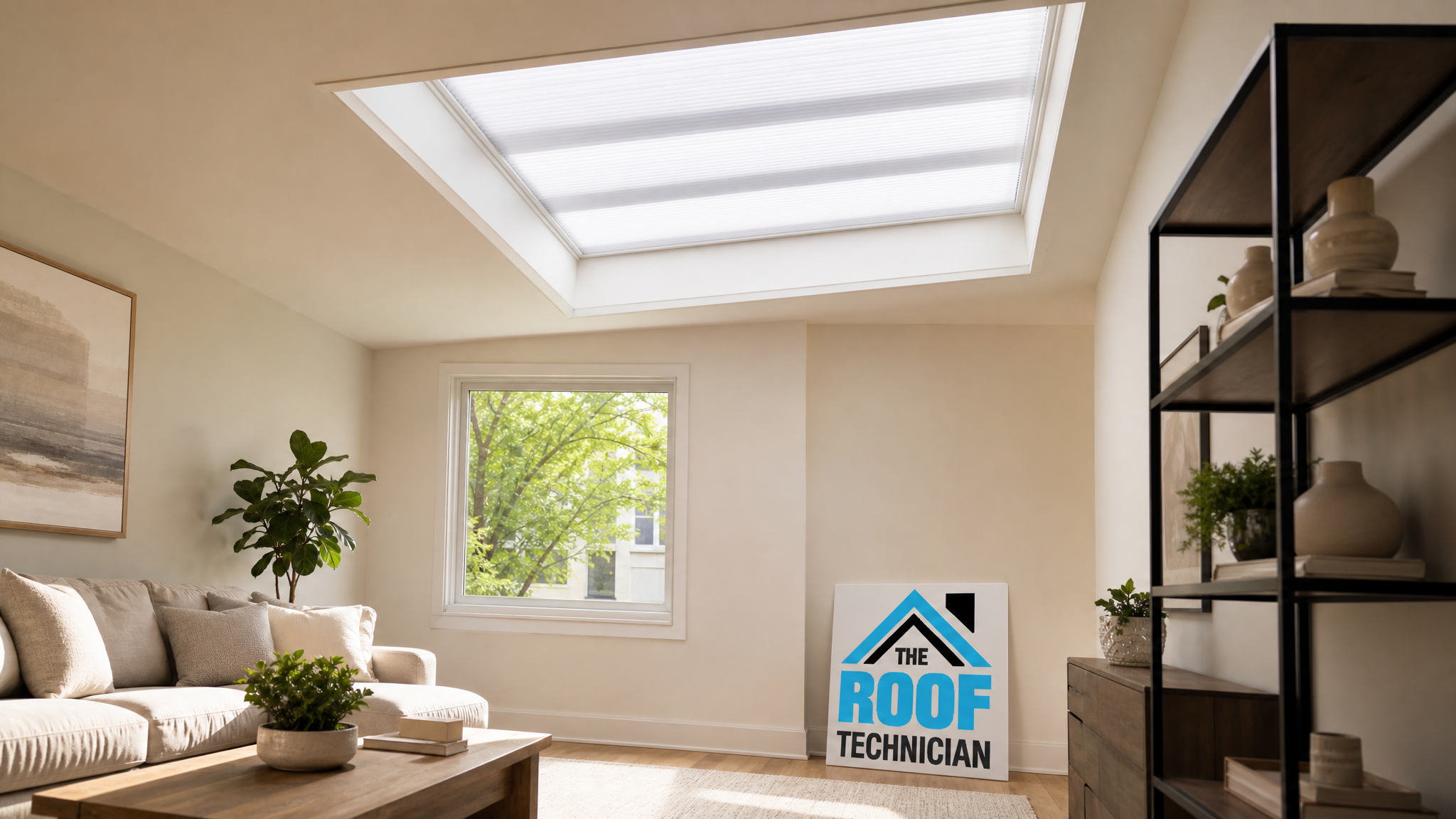
Why Skylight Shades Summer Heat Toronto Homes Experience Is a Serious Problem
Toronto sits at approximately 43 degrees north latitude, which means summer sun angles are relatively high — high enough to send direct solar radiation straight down through a roof-mounted skylight for hours at a time. Unlike a vertical window, a skylight receives solar energy at a near-perpendicular angle during midday, making it dramatically more effective at heating a room than a same-sized south-facing window. In fact, a single square metre of unshaded skylight glass can introduce the equivalent heat load of a 500-watt space heater operating continuously during peak summer hours.
The practical result: rooms with large skylights can be 8 to 12 degrees Celsius warmer than adjacent rooms without them during a Toronto July afternoon. Your HVAC system compensates by running longer and harder, driving electricity costs up and equipment lifespan down. In condominiums and new-build homes across Markham, Vaughan, and Oakville, skylights are increasingly standard features — which means the demand for effective skylight shades summer heat toronto control solutions is higher than it has ever been.
Beyond raw heat, unshaded skylights expose interior surfaces to ultraviolet radiation that accelerates the fading of hardwood floors, upholstery, artwork, and cabinetry. A quality skylight shade with UV-blocking fabric eliminates most of this risk entirely while still allowing diffused visible light through.
There is also a comfort dimension beyond temperature. Direct summer sunlight streaming through an unshaded skylight creates harsh glare that makes screens difficult to read, disrupts sleep in bedroom applications, and forces occupants to rearrange furniture or cover surfaces with makeshift solutions. Proper skylight shades summer heat toronto homeowners install eliminate all these problems simultaneously.
Types of Skylight Shades and Blinds: What Is Available in 2026
The Canadian market now offers five primary categories of skylight shade technology, each suited to different priorities, skylight types, and budgets. Understanding the distinctions is essential before you purchase anything.
Cellular honeycomb shades are the most popular choice for skylight shades summer heat toronto applications because they combine excellent insulation (the air-trapping honeycomb cells resist heat transfer in both directions), good light filtering, and relatively modest cost. They are available in single-cell, double-cell, and triple-cell constructions — triple-cell providing the highest insulation value and the most uniform light diffusion.
Room-darkening roller shades use a dense woven or coated fabric to block most visible light and a high proportion of solar heat gain. They are the right choice for bedrooms, home theatres, and nurseries where maximum light control is needed. Solar transmittance in quality room-darkening fabrics ranges from 1 to 5 percent, meaning they block 95 to 99 percent of incoming sunlight.
Light-filtering roller shades use an open-weave fabric with solar transmittance typically between 5 and 14 percent. They reduce glare dramatically and cut heat gain substantially while maintaining a sense of connection to the outdoor sky — an important consideration for homeowners who installed their skylight specifically for the sky view.
Venetian-style skylight blinds are manufactured by a small number of specialist suppliers and use horizontal aluminium or fabric slats angled to redirect incoming sunlight toward the ceiling rather than blocking it. This creates a pleasant diffused glow without the flat, uniform appearance of a shade. They are more expensive and mechanically complex but offer the most precise light direction control.
Motorised and smart-home integrated shades represent the fastest-growing segment. Solar-powered motors are now standard on premium units — they charge from the skylight’s own ambient light and require no electrical wiring. Integration with Apple HomeKit, Google Home, and Amazon Alexa is common at the mid-to-upper price tier.
| Shade Type | Solar Heat Reduction | Light Transmittance | Best Application | Typical Installed Cost (CAD) |
|---|---|---|---|---|
| Cellular honeycomb (double-cell) | 55–65% | 20–35% | Living rooms, kitchens | $380–$650 |
| Room-darkening roller | 70–80% | 1–5% | Bedrooms, nurseries, media rooms | $320–$580 |
| Light-filtering roller | 40–60% | 5–14% | Open-plan living, offices | $280–$520 |
| Venetian-style blind | 50–70% (adjustable) | 0–30% (adjustable) | Living rooms, studies | $520–$900 |
| Motorised solar-powered shade | Varies by fabric | Varies by fabric | High or inaccessible skylights | $650–$1,400 |
Choosing the Right Shade Fabric for Toronto’s Summer Climate
Fabric selection is where most homeowners make their biggest mistakes. The Canadian summer presents a specific set of demands: high peak solar intensity in June, July, and August; relatively high humidity on many days; and UV index readings that regularly reach 8 or 9 during midday in the GTA. Your chosen fabric must handle all three conditions without degrading, staining, or losing its dimensional stability.
Look for fabrics rated to at least a 4 on the Blue Wool Scale for UV resistance, or alternatively certified to AATCC Test Method 16 for colourfastness to light. Polyester fabrics with acrylic coatings generally outperform uncoated polyester and are significantly more durable than natural fibre options in rooftop light exposure. Many premium shade manufacturers now publish a Solar Reflectance Index (SRI) for their fabrics — a higher SRI means more heat is reflected away from the glass before it enters your home.
Colour also matters more than most people realise. White and off-white fabrics reflect the most solar energy, making them the most effective at reducing heat gain — but they also show soiling more readily in dusty environments. Mid-tone greys and taupes offer a compromise between solar performance and visual cleanliness. Dark fabrics absorb solar energy and re-radiate some of it inward, making them less effective for heat control even though they appear to block more light.
For homeowners in Brampton, Mississauga, and Burlington who have skylights over kitchens or bathrooms, moisture resistance is critical. Look for fabrics with an antimicrobial treatment or a solid vinyl facing on the interior side — these resist the mildew growth that can occur when condensation cycles between the glass and the shade fabric during humid summer evenings.
Manual vs. Motorised Skylight Shades: Which Makes Sense for Your Home
This is the most common question we hear from homeowners evaluating skylight shades summer heat toronto options. The answer depends almost entirely on how accessible your skylight is.
If your skylight sits in a flat ceiling over a first-floor room and you can comfortably reach the operating cord or wand while standing on the floor or a short step stool, a manual shade is entirely practical and meaningfully less expensive. Manual systems have no electronics to fail, no batteries to replace, and no compatibility issues with evolving smart-home platforms. A quality manual cellular shade can last 15 to 20 years with essentially no maintenance beyond occasional dusting.
If your skylight is in a vaulted ceiling, above a stairwell, in an upper-storey location, or at any height where operating it would require a ladder, motorisation is not a luxury — it is a safety and usability necessity. A shade you cannot conveniently operate is a shade you will never close, which means you paid for heat and UV protection you are not using. Solar-powered motor units are now reliable enough that we recommend them as the default choice for any skylight above approximately 2.7 metres from the floor.
Motorised systems also solve the practical problem of operating multiple skylights consistently. A home with three or four skylights — common in the newer subdivisions of Vaughan and Markham — becomes much easier to manage when all shades can be closed simultaneously from a wall switch or a phone app at the start of a hot summer afternoon.
Smart-home integration adds genuine value for homeowners who already have automated thermostats or home-automation platforms. Linking your skylight shades to a temperature sensor so they close automatically when the indoor temperature exceeds a set threshold is a practical set-and-forget solution that maximises the energy savings of skylight shades summer heat toronto control without requiring you to remember to close them every day.
Professional Installation vs. DIY: What Toronto Homeowners Should Know
Skylight shade mounting systems vary significantly depending on the skylight manufacturer and model. Velux, Fakro, Sun-Tek, and Wasco all use different mounting channel geometries, and shades are generally not interchangeable between brands. This means that before purchasing any shade, you need to accurately identify your skylight’s manufacturer and model number — typically found on a label on the frame, the flashing, or the glass unit itself.
For ground-floor skylights with flat ceilings, DIY installation is achievable if you are comfortable working on a ladder and following detailed instructions. Most manufacturer-supplied shade kits for their own brand skylights clip directly into pre-formed channels in the skylight frame with no drilling or special tools required. The process typically takes 30 to 60 minutes per skylight.
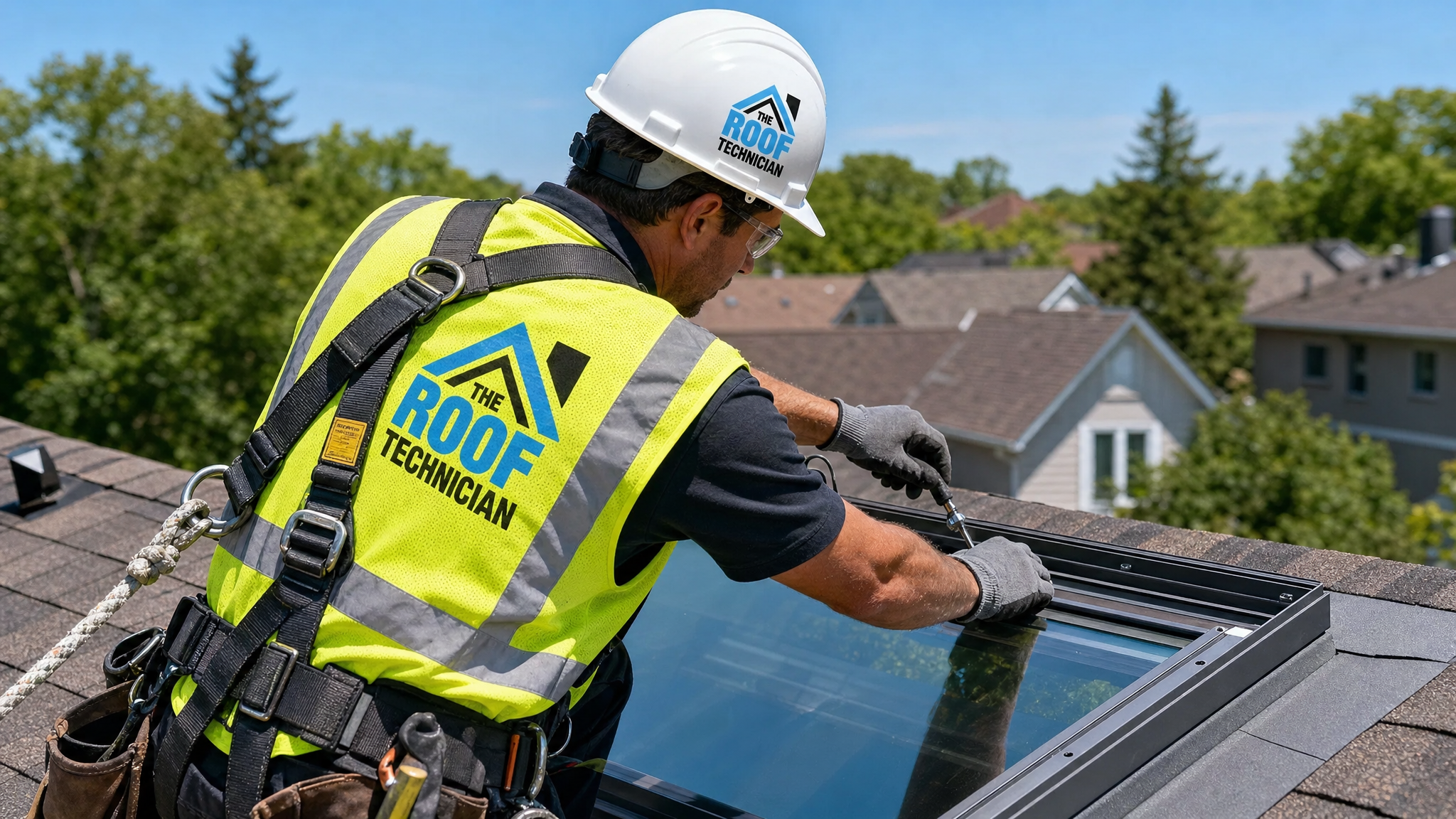
Professional installation is strongly recommended for any of the following situations: vaulted or cathedral ceilings; skylights with unusual dimensions or non-standard mounting geometry; motorised shades that require programming or pairing with a hub; flat-roof curb-mounted skylights; or cases where the skylight itself shows signs of seal degradation, condensation between panes, or frame damage. In these situations, the installation process may reveal underlying issues with the skylight unit itself that should be addressed at the same time.
Our team regularly inspects skylights as part of shade installation visits and has identified dozens of cases where a skylight needing roof repair would have been missed without the close-up access that a shade installation provides. Catching a failing skylight seal in June, before the heavy summer rain events that Toronto regularly experiences in July and August, can prevent significant interior water damage.
| Installation Factor | DIY Suitable | Professional Recommended |
|---|---|---|
| Ceiling height | Under 2.7 m (accessible from floor) | Over 2.7 m, vaulted, or stairwell |
| Shade type | Manual clip-in, brand-matched unit | Motorised, retrofitted third-party, custom |
| Skylight condition | New, sealed, no visible issues | Any signs of condensation, leaks, or frame damage |
| Number of units | 1–2 identical skylights | 3+ skylights or mixed models |
| Smart-home integration | Single-shade Bluetooth only | Multi-shade hub pairing, whole-home automation |
Energy Savings and Return on Investment for Skylight Shades in Toronto
One of the most common questions we receive is whether skylight shades actually pay for themselves. The short answer for most Toronto homes is yes — and often within two to four summer seasons. Here is how the maths typically works out.
A mid-size Toronto home with two or three unshaded skylights over living spaces can see its central air-conditioning system run 15 to 25 percent longer during summer peak hours to compensate for skylight solar heat gain. At Ontario’s current residential electricity rates (roughly $0.14 to $0.17 per kilowatt-hour on time-of-use pricing during peak hours), this represents a meaningful recurring cost that grows with each passing summer.
Installing quality cellular shades on those same skylights reduces solar heat gain by 55 to 65 percent, proportionally reducing the additional cooling load. For a home spending $350 to $500 per summer month on cooling, even a 15 percent reduction in cooling demand represents $50 to $75 saved per month — $150 to $225 over a typical three-month Toronto cooling season. Against a shade installation cost of $380 to $650 per skylight, payback is achieved in two to four years, with ongoing savings thereafter.
The UV protection benefit is harder to quantify but real. Hardwood flooring restoration costs $4,000 to $12,000 for a typical Toronto home. Fading begins with cumulative UV exposure, and skylights deliver UV at a higher dose rate than vertical windows because of the perpendicular angle of incidence. A shade that prevents even a portion of that fading can represent savings far exceeding the cost of the shade system over the lifetime of the flooring.
For homeowners considering roof replacement alongside skylight upgrades, summer is an ideal time to bundle the work. Combining roof and skylight shade installation in a single mobilisation saves on scaffolding and access costs and ensures the new roof flashing and skylight curb are inspected at the same time as the shade hardware is mounted.
Proper attic ventilation also works in concert with skylight shades. A home with adequate attic ventilation removes heat that builds up in the roof assembly before it can radiate down into living spaces — meaning skylight shades and good attic ventilation are complementary investments that together deliver more summer comfort than either one alone.
Maintenance Tips to Keep Your Skylight Shades Performing All Summer
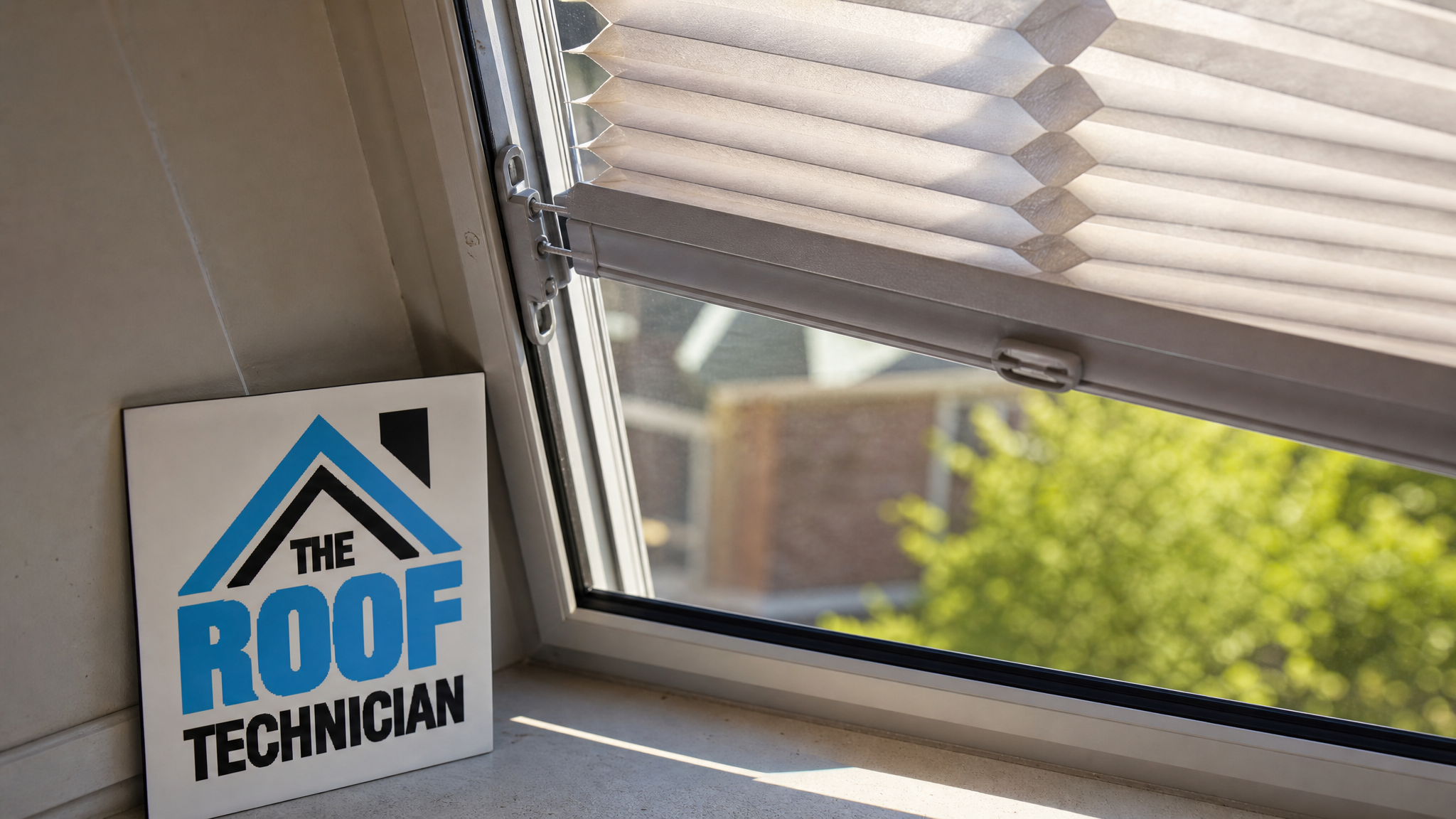
A quality skylight shade system requires minimal maintenance but does need periodic attention to perform at its best over a long service life. The warm months from June through September are the period of peak use and the most important time to keep the system operating correctly.
Dust accumulates on shade fabric from the skylight well, particularly in homes near major roads in Toronto, Brampton, or Richmond Hill. Quarterly vacuuming with a soft upholstery brush attachment, or a gentle wipe-down with a barely damp microfibre cloth, is sufficient for most fabrics. Avoid saturating the fabric with water or using cleaning agents not approved by the manufacturer — some specialty coatings are damaged by solvents or strong detergents.
For motorised shades, check the motor’s charge indicator (where provided) at the start of each summer season. Solar-powered motors should be fully charged after a few days of summer sun exposure, but a unit that has been unused through a long cloudy winter spell may need a few days to recover its charge before it operates reliably. Most motors also allow a manual override for emergency operation in low-charge conditions.
Inspect the mounting rails or channels once per summer for any signs of moisture intrusion, corrosion, or warping. Minor moisture entry around a skylight that would not cause immediate water damage to the room below can still cause corrosion of aluminium rail components over time. If you see white powdery deposits on aluminium hardware, rust staining on steel components, or any signs of water tracking along the frame, have the skylight inspected. You can read what previous customers have experienced on our reviews page — skylight inspection and repair is one of our most consistently appreciated services.
Check operating cords and tensioners on manual shades annually. Cords can fray or develop kinks if operated repeatedly under tension at awkward angles, and a broken cord on a skylight over a stairwell creates a replacement challenge that is much easier to avoid than to fix after the fact. Replacing a fraying cord in summer while the shade is still functional is a 30-minute job; replacing it after it breaks and the shade is stuck open during an August heat wave is an emergency.
| Maintenance Task | Frequency | DIY or Professional | Estimated Time |
|---|---|---|---|
| Fabric dusting / vacuuming | Every 3 months | DIY | 5–10 minutes per shade |
| Motor charge check (solar units) | Start of each season | DIY | 2 minutes per shade |
| Mounting hardware inspection | Annually (early summer) | DIY or professional | 10–15 minutes per shade |
| Operating cord inspection | Annually | DIY | 5 minutes per shade |
| Full skylight seal and flashing inspection | Every 2–3 years | Professional | 30–60 minutes per unit |
What are the best skylight shades for summer heat control in Toronto homes?
How much do skylight shades cost installed in Toronto in 2026?
Can I install skylight shades myself, or do I need a professional?
Do skylight shades summer heat toronto solutions actually reduce energy bills?
Are motorised skylight shades worth the extra cost in Toronto?
How do I know if my skylight needs shading or replacement?
Schedule Your Skylight Shades Summer Consultation Today
Managing summer heat through your skylights does not have to be a guessing game. The Roof Technician brings years of GTA skylight experience to every assessment — we identify the right shade system for your specific unit, flag any underlying skylight issues before they become expensive repairs, and complete installations cleanly and on time. With summer already underway, there is no better moment to act than right now.
Call us today at (416) 826-0040 or request a free consultation to get started.
The Roof Technician proudly serves Toronto, Mississauga, Vaughan, Markham, Brampton, Oakville, and Burlington.