One of the most important decisions Toronto homeowners face — whether during new construction, a major renovation, or a roof replacement — is understanding the fundamental differences between flat and pitched roofing systems. The flat roof vs pitched roof toronto comparison involves far more than aesthetics: each system uses completely different materials, installation methods, drainage mechanisms, maintenance requirements, and cost structures. Many Toronto homes actually feature both roof types — a pitched main roof with a flat section over a garage, addition, or porch — which means many homeowners need to understand both systems to make informed decisions about their complete roofing envelope. This guide provides a thorough, unbiased comparison of both systems in the context of Toronto’s demanding climate.
Flat Roofing Systems: Materials, Performance, and Costs
What Is a Flat Roof?
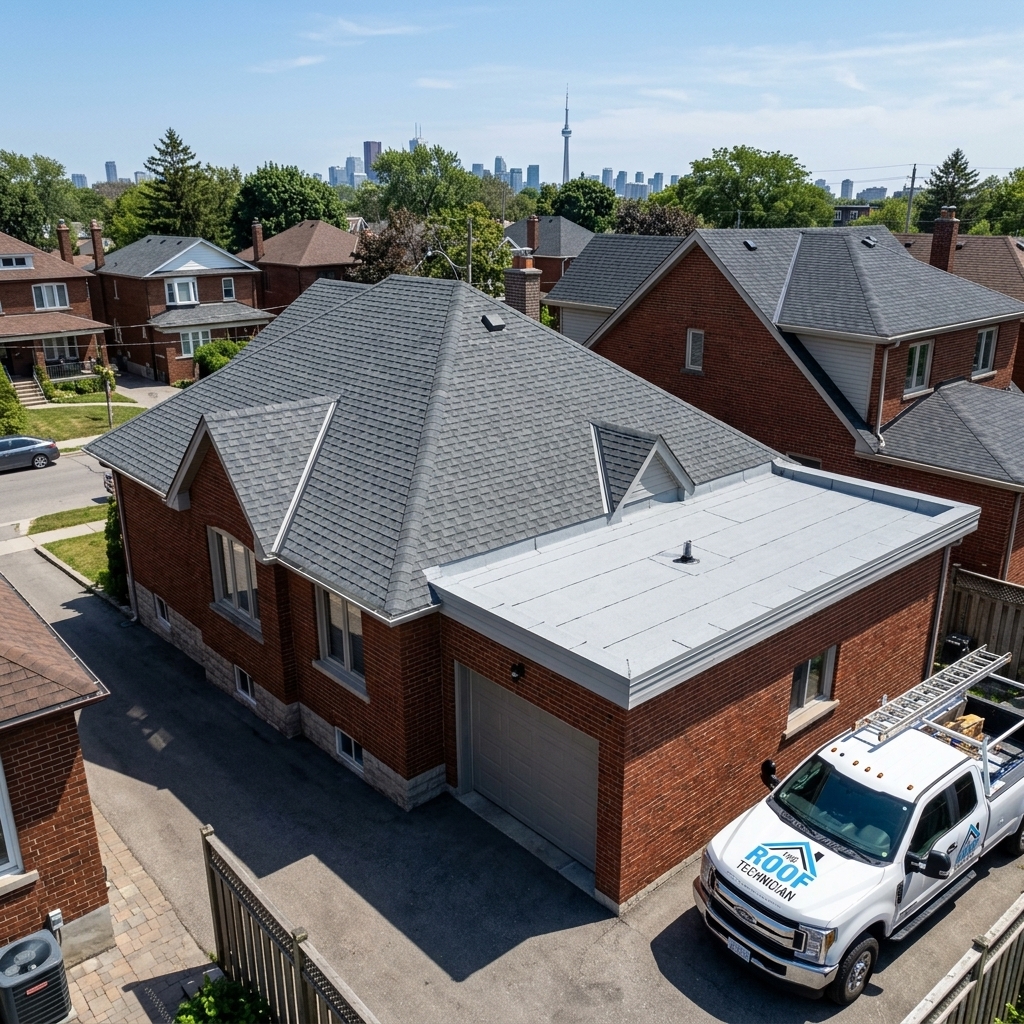
A flat roof is not actually flat — it is a low-slope roof with a pitch of less than 2:12 (less than 9.5 degrees), designed to shed water through a controlled drainage system of internal drains, scuppers, or tapered insulation that directs water to designated exit points. Because water does not run off a flat roof as quickly or completely as it does on a steep slope, flat roofs rely on continuous membrane waterproofing rather than overlapping shingle layers. This fundamental difference in drainage philosophy drives every other difference between flat and pitched roofing systems — materials, installation methods, maintenance requirements, and failure modes.
Flat Roof Materials for Toronto
| Material | Cost/sq ft | Lifespan | Pros | Cons |
|---|---|---|---|---|
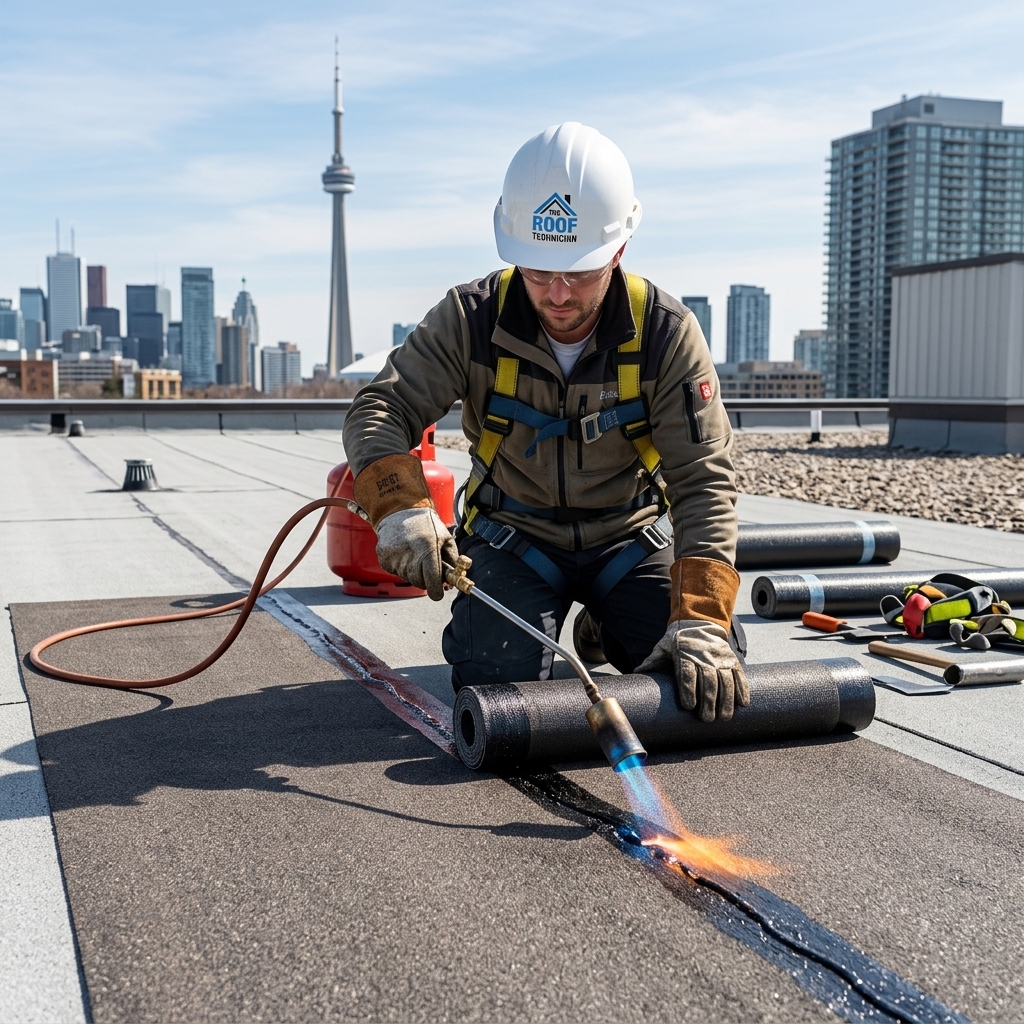
| Modified Bitumen (Mod-Bit) | $6-$10 | 15-20 years | Excellent waterproofing, torch-applied for strong seams, good freeze-thaw performance | Requires skilled torch application, shorter lifespan than alternatives |
| EPDM Rubber | $5-$8 | 20-25 years | Lightweight, flexible, good UV resistance, cost-effective | Seams can fail over time, puncture-prone, black surface absorbs heat |
| TPO (Thermoplastic Polyolefin) | $7-$12 | 20-30 years | White reflective surface, heat-welded seams, energy efficient | Higher cost, newer technology with less long-term track record |
| PVC Membrane | $8-$14 | 25-30 years | Superior chemical resistance, heat-welded seams, very durable | Highest cost, can become brittle in extreme cold |
| Built-Up Roofing (BUR) | $5-$9 | 15-25 years | Multi-layer redundancy, proven technology, gravel surface | Heavy, labour-intensive installation, difficult to locate leaks |
Flat Roof Advantages
- Usable space: Flat roofs can accommodate rooftop patios, gardens, HVAC equipment, and solar panels without the structural complications of mounting on a slope
- Lower initial cost: For equivalent coverage area, flat roof installation is typically 20 to 30 percent less expensive than pitched roof construction due to simpler framing and reduced material quantity
- Easier maintenance access: Walking on a flat roof for inspections, cleaning, and minor repairs is straightforward and safe — unlike steep-slope work that requires fall protection equipment
- Modern aesthetics: Flat roofs enable contemporary architectural designs that are increasingly popular in Toronto’s urban infill developments and modern custom homes
Flat Roof Challenges in Toronto
- Drainage dependency: Any failure in the drainage system — clogged drains, sagging membrane creating ponding areas, or frozen drain pipes — leads directly to water infiltration. Ponding water (standing water that remains more than 48 hours after rain) accelerates membrane deterioration and adds weight loading
- Shorter lifespan: Flat roof membranes typically last 15 to 25 years compared to 25 to 50 years for quality pitched roof materials, resulting in more frequent replacement cycles
- Snow and ice management: Flat roofs cannot shed snow naturally. Heavy snow accumulation must be monitored and removed when loading approaches structural limits. Ice formation around drains can block drainage and cause ponding
- Temperature extremes: The membrane surface absorbs full solar exposure in summer (reaching 75°C+) and endures the most severe freeze-thaw cycling in winter, accelerating material aging
Pitched Roofing Systems: Materials, Performance, and Costs
What Is a Pitched Roof?
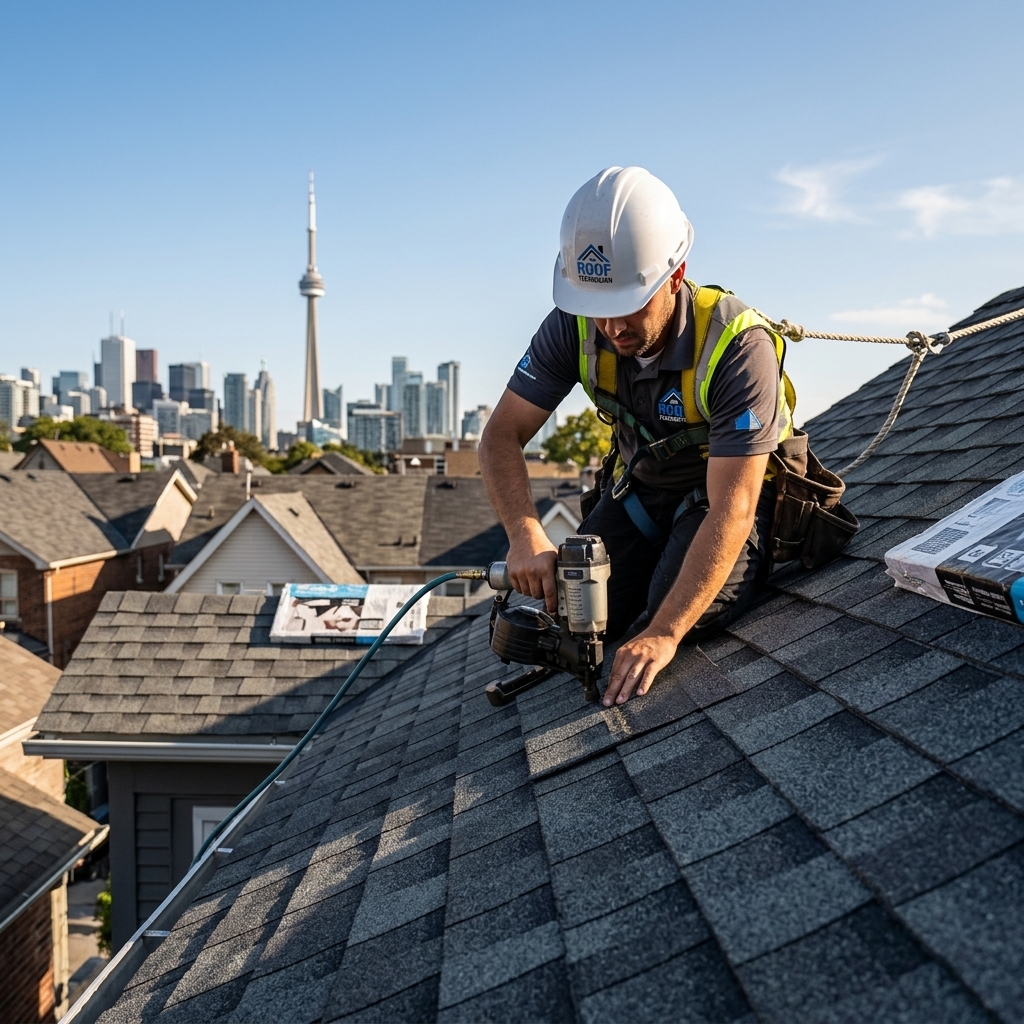
A pitched roof has a slope of 4:12 or greater (18.4+ degrees), designed to shed water and snow by gravity across overlapping material layers — primarily asphalt shingles in Toronto’s residential market. The steeper the pitch, the faster water and snow clear the surface, reducing the time water spends in contact with the roofing material and minimizing the opportunity for infiltration. Pitched roofs rely on a layered defence system: the shingles shed the majority of water, the underlayment provides a secondary waterproofing barrier, and ice and water shield at vulnerable areas (eaves, valleys, penetrations) provides a tertiary seal against water that penetrates the upper layers.
Pitched Roof Materials for Toronto
| Material | Cost/sq ft | Lifespan | Best For |
|---|---|---|---|
| Three-tab asphalt shingles | $3-$5 | 15-25 years | Budget-friendly, rental properties, simple rooflines |
| Architectural laminate shingles | $4-$7 | 30-50 years | Best value — most popular choice for Toronto homes |
| Designer/luxury shingles | $7-$12 | 40-50 years | Premium aesthetics — slate, shake, or tile appearance |
| Metal roofing (standing seam) | $12-$25 | 40-60 years | Maximum longevity, energy efficiency, modern look |
| Cedar shake | $10-$20 | 25-40 years | Heritage homes, natural appearance |
Pitched Roof Advantages
- Natural drainage: Gravity does the work — water and snow clear the roof surface quickly, minimizing water contact time and reducing infiltration risk
- Longer lifespan: Quality pitched roof materials (architectural shingles, metal) last 30 to 60 years — significantly longer than flat roof membranes
- Attic space: The cavity between the ceiling and the roof provides natural insulation, ventilation space, and potential storage or living area
- Better snow shedding: Steep pitches allow snow to slide off naturally (or with minimal assistance from a roof rake at the eaves), reducing structural loading
- Aesthetic variety: Pitched roofs offer unlimited design options — hip, gable, mansard, gambrel, and complex multi-gable configurations that define the character of the home
Pitched Roof Challenges in Toronto
- Higher initial cost: The structural framing, greater material quantity, and more complex installation of a pitched roof make it 20 to 40 percent more expensive to construct than a flat roof of equivalent coverage
- Difficult maintenance access: Inspections, repairs, and cleaning on steep-slope roofs require ladders, fall protection equipment, and professional expertise — increasing the cost of routine maintenance
- Ice dam vulnerability: The transition zone at the eave — where the warm attic meets the cold overhang — is the primary location for ice dam formation on pitched roofs, requiring proper insulation and ventilation to prevent
- Wind exposure: Steep roof faces present a larger surface area to wind, increasing uplift forces during severe storms — making wind-rated shingle selection critical
Maintenance Requirements: Flat vs Pitched
The ongoing maintenance burden differs significantly between flat and pitched roofing systems, and this difference should factor heavily into your decision. Flat roofs require more frequent and more hands-on maintenance than pitched roofs. At minimum, flat roof drains and scuppers must be cleared of debris every season — particularly in autumn when leaves can completely block drainage openings within a single storm. The membrane surface should be visually inspected twice annually for blistering, cracking, seam separation, and ponding areas. Any ponding water that remains more than 48 hours after rain indicates a drainage deficiency that must be corrected before the standing water accelerates membrane deterioration.
Pitched roofs require less frequent maintenance but the maintenance that is needed is more difficult to perform due to access challenges on steep slopes. Annual eavestrough cleaning, periodic professional inspections, and prompt repair of damaged shingles or flashing are the primary maintenance requirements. The advantage of pitched roofs is that most maintenance tasks are reactive rather than proactive — you address problems as they appear rather than performing regular preventive maintenance cycles. However, this advantage can become a disadvantage if homeowners interpret the lower maintenance burden as no maintenance required and neglect the roof until a problem becomes a costly emergency.
Hybrid Roofs: When Your Toronto Home Has Both
Many Toronto homes — particularly those with additions, attached garages, covered porches, or bay window bump-outs — feature both flat and pitched roof sections on the same structure. These hybrid configurations require a contractor who is equally skilled in both roofing systems and understands the critical transition details where flat and pitched sections meet. The intersection between a flat roof and an adjoining pitched roof or wall is one of the most leak-prone areas on any home, requiring carefully designed and installed step flashing, counter-flashing, and membrane termination details that account for the different movement characteristics of each material system. The Roof Technician has extensive experience with hybrid roof configurations common throughout Toronto’s diverse housing stock and treats every transition point as a critical waterproofing detail that receives the highest level of attention during installation.
Which System Should You Choose?
The flat roof vs pitched roof decision ultimately depends on your specific situation. Choose a flat roof if you are covering a garage, addition, or porch extension where a pitched roof is architecturally impractical, if you want usable rooftop space for a patio or equipment, if you prefer a modern architectural aesthetic, or if you need to minimize initial construction cost. Choose a pitched roof if you want maximum lifespan and minimum long-term cost, if you prefer the superior snow and water shedding that gravity provides in Toronto winters, if you want the widest range of material and aesthetic options, or if you prefer lower ongoing maintenance requirements. In either case, the quality of materials and installation workmanship matters far more than the system type — a well-installed flat roof will outperform a poorly installed pitched roof every time.
Side-by-Side Comparison
| Factor | Flat Roof | Pitched Roof |
|---|---|---|
| Initial cost | Lower (20-30% less) | Higher |
| Lifespan | 15-25 years | 25-60 years |
| Drainage | Engineered drainage system required | Natural gravity drainage |
| Snow management | Manual removal may be needed | Natural shedding on steep pitches |
| Maintenance access | Easy — walk-on surface | Requires ladders and safety equipment |
| Usable space | Rooftop patio, HVAC, solar | Attic storage or living space |
| Aesthetics | Modern/contemporary | Traditional/versatile |
| Replacement frequency | Every 15-25 years | Every 25-50 years |
Is a flat roof or pitched roof better for Toronto?
How long does a flat roof last in Toronto?
What is the best flat roof material for Toronto climate?
Can I convert a flat roof to a pitched roof?
Do flat roofs leak more than pitched roofs?
Which roof type is more energy efficient?
Expert Guidance for Every Roof Type — Call The Roof Technician
Whether your Toronto home has a flat roof, a pitched roof, or both — The Roof Technician has the expertise and manufacturer certifications to deliver premium results with every roofing system. We provide honest, unbiased recommendations based on your home’s specific architecture, your budget, and the long-term performance you need from your roofing investment.
Call us today at (416) 826-0040 or request your free flat or pitched roof assessment online.
The Roof Technician provides expert flat and pitched roofing services across Toronto, Mississauga, Brampton, Oakville, Burlington, Vaughan, Markham, Richmond Hill, and the entire Greater Toronto Area.