In the extreme, fluctuating climate of the Greater Toronto Area, a residential roof is far more than a simple waterproof barrier against the rain. It is a highly complex, dynamic thermal engine designed to exhaust intense heat and aggressive moisture safely away from the structural integrity of your home. However, The Roof Technician consistently responds to thousands of calls across the GTA where seemingly brand-new asphalt shingles are curling, blistering, and failing years before their intended lifespan. The culprit is rarely defective roofing materials; overwhelmingly, the root cause traces directly back to catastrophic roof ventilation mistakes Toronto homeowners and inexperienced contractors make. When the critical thermal balance between cool intake air at the eaves and hot exhaust air at the roof peak is broken, the attic becomes an aggressive oven in the summer and a humid rainforest in the winter. This exhaustive 2026 guide forensically analyzes the absolute worst ventilation errors destroying Toronto roofs, and how to definitively correct them to save your home.
The Physics of Proper Attic Ventilation
Before dissecting the mistakes, you must understand the immutable physics of airflow. A roof must breathe. The entire system relies on the basic thermodynamic principle that hot air naturally rises (convection). For a ventilation system to function correctly, it demands two perfectly balanced components:
- Intake Ventilation (Soffit Vents): Located at the absolute lowest point of the roofline, underneath the overhanging eaves. These draw freezing cold exterior air into the attic space during winter, and cooler ambient air during the summer.
- Exhaust Ventilation (Ridge Vents or Box Vents): Located at the highest geometric point of the roof. As the hot, humid air inside the attic naturally rises, it forcefully exits through these vents, pulling a fresh draft of cool air behind it from the soffits.
When this continuous, passive vacuum system operates flawlessly, the temperature of the plywood roof deck remains physically identical to the exterior outdoor temperature. When this system is obstructed, disaster is imminent.
Mistake #1: Blocking Intake Vents With Heavy Insulation
This is undeniably the single most destructive roof ventilation mistake Toronto roofing contractors encounter. In a desperate, misguided attempt to reduce aggressive winter heating bills, homeowners or amateur insulation contractors will heavily blow loose-fill cellulose or aggressively lay thick pink fiberglass batts deep into the tight corners of the attic.
While upgrading to R-60 insulation is fantastic for energy efficiency, pushing that thick insulation directly over the soffit vents instantly chokes the entire system. It is the architectural equivalent of suffocating your house. Without intake air, the ridge vents at the top of the roof cannot exhaust the hot air, creating a stagnant, hyper-heated environment. The absolute critical fix for this is the aggressive installation of Attic Baffles (Rafter Vents). These are rigid plastic or foam channels stapled directly against the underside of the roof deck, creating a permanent, uncrushable tunnel that forces incoming soffit air safely past the thick insulation and up into the open attic volume.
Mistake #2: Mixing Exhaust Vent Types
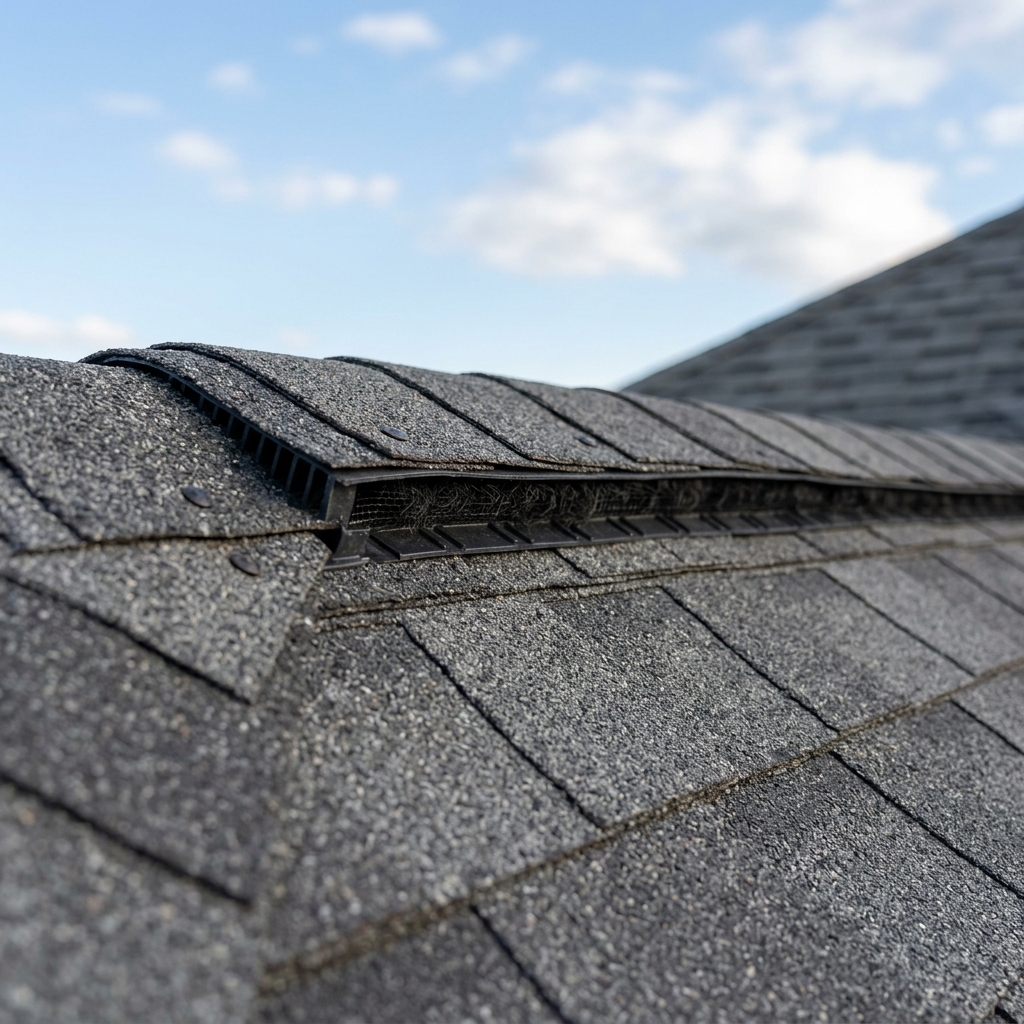
A shocking number of Toronto roofs feature a chaotic mixture of different exhaust vent technologies installed haphazardly on the same roof plane. You will frequently see a modern ridge vent running along the peak, but supplemented with two or three traditional square metal box vents (turtle vents), and perhaps a spinning turbine vent added by a previous homeowner.
This breaks the laws of fluid dynamics. Air always follows the path of least resistance. Instead of pulling fresh, cold air all the way from the soffits at the bottom of the roof, a strong ridge vent will simply suck air directly from the nearby box vent located just a few feet below it. This entirely “short-circuits” the ventilation system. The lower 80% of your attic space becomes completely stagnant, trapping brutal heat and moisture, while the top 20% pointlessly circulates air in a tight loop. You must commit to exactly one type of exhaust ventilation per contiguous attic space.
| Ventilation Mistake | The Hidden Physical Consequence | Required Professional Fix | Cost of Neglect |
|---|---|---|---|
| Insulation Blocking Soffits | Total airflow suffocation. Stagnant attic air hyper-heats the roof deck. | Excavate insulation and staple rigid plastic baffles into every rafter bay. | Premature shingle blistering. |
| Mixing Ridge & Box Vents | Short-circuited airflow. The lower 80% of the attic receives zero air exchange. | Seal and remove the box vents, allowing the ridge vent to pull from the soffits. | Massive black mold growth. |
| Painted-Over Soffit Vents | Micro-perforations are glued shut by heavy exterior acrylic paint. | Completely replace the aluminum soffit panels with high-flow vented panels. | Wood rot in the roof framing. |
| Exhausting Bathrooms into Attic | Pumping hundreds of gallons of humid shower steam directly into the freezing attic. | Hard-pipe the exhaust fan through the roof using a dedicated, insulated, flappered vent hood. | Catastrophic winter frost and rot. |
| Power Vents without Intake | The aggressive motor creates a vacuum that sucks expensive air-conditioning out of your living room. | Calculate exact Net Free Area (NFA) and drastically increase soffit intake capacity. | Spiking summer hydro bills. |
Mistake #3: The Bathroom Exhaust Fan Disaster
It is stunningly common in older Toronto bungalows built in the 1960s and 70s to discover that the bathroom ceiling exhaust fan does not actually vent to the outside world. Instead, the flexible plastic hose simply terminates randomly inside the dark attic, often buried beneath insulation.
During a brutal Toronto winter, you take a hot shower and run the fan. You are actively pumping a dense, highly concentrated cloud of hot, humid steam directly into an attic space that is -10°C. The moment that steam hits the freezing plywood roof deck or the cold shingle nails, it violently condenses into liquid water and then freezes solid into a thick layer of white frost. When the sun rises and warms the roof, that frost melts, raining liquid water down onto your insulation, destroying its R-value, and soaking your drywall ceiling. Over a few seasons, the plywood deck rots completely through. The only acceptable solution is hard-piping the exhaust fan utilizing insulated ducting entirely out through a dedicated, specialized flapper-vent installed directly into the roof replacement system.
The 2026 Consequences: Voided Shingle Warranties
Homeowners often invest heavily in premium architectural shingles boasting a “50-Year Lifetime Warranty,” assuming they are permanently protected. However, if you read the microscopic fine print on any major shingle manufacturer’s legal document (such as GAF, CertainTeed, or IKO), they aggressively mandate that the attic must meet specific ventilation codes (typically the 1/300 rule: 1 square foot of net free ventilation area for every 300 square feet of attic floor space).
If your shingles blister, curl, and fail at year 12 because your attic lacks intake baffles and reaches 160°F (71°C) in July, baking the volatile oils out of the asphalt, the manufacturer will send an inspector. The inspector will instantly document the inadequate ventilation and completely void your multi-thousand-dollar warranty on the spot. Ensuring flawless ventilation is the absolute only way to protect your financial investment.
The Ice Dam Epidemic: A Direct Result of Poor Ventilation
Ice dams are the terror of Toronto winters, and they are entirely the result of massive roof ventilation mistakes. If your attic lacks sufficient insulation and ventilation, expensive heat escapes from your living room into the attic space. This trapped heat warms the underside of the roof deck, melting the snow resting on the shingles above. This meltwater trickles down the roof until it hits the overhanging eaves (which extend past the warm exterior walls and are therefore freezing cold). The water instantly refreezes, creating a massive, solid ridge of ice—the ice dam. As the cycle repeats, the dam grows, eventually trapping massive pools of water on the roof that back up violently underneath the shingles and destroy your ceilings.
The definitive cure is ensuring continuous, powerful, freezing airflow from the soffits, sweeping along the underside of the roof deck, and exiting the ridge, ensuring the entire roof surface remains uniformly below freezing all winter.
| Ventilation Component | Optimal 2026 Standard for Toronto | Red Flags to Identify |
|---|---|---|
| Soffit Intake Panels | Continuous, fully perforated aluminum running the entire perimeter of the house. | Solid wood soffits, heavily painted-over perforations, or completely blocked by insulation batts. |
| Attic Baffles | Rigid polystyrene or PVC channels stapled to every single rafter bay along the eaves. | Crushed cardboard baffles, missing baffles, or fiberglass stuffed tightly against the roof deck. |
| Ridge Exhaust Vent | Externally baffled continuous ridge vent (e.g., ShingleVent II) covered by specialized cap shingles. | Ridge vent installed alongside competing box vents, or cut too short along the peak. |
| Gable Vents | Used purely for intake in very specific historic architectural designs. | Combining gable vents with ridge vents, which severely short-circuits convective airflow. |
| Insulation Depth | R-60 standard (roughly 18 to 22 inches of blown-in cellulose or fiberglass). | Insulation packed tightly to the roof edge, choking off the vital soffit intake air entirely. |
| Ventilation Audit Metric | The Professional Assessment Standard | The Consequence of Ignoring It |
|---|---|---|
| Net Free Area (NFA) Ratio | 1 sq. ft. of ventilation per 300 sq. ft. of attic floor (1/300 rule). | Manufacturer legally voids the multi-thousand-dollar shingle warranty. |
| Intake-to-Exhaust Balance | 60% intake (soffits) and 40% exhaust (ridge) is the elite standard. | Dangerous negative pressure vacuum sucks conditioned air out of the living space. |
| Thermal Imaging Scan | Identifies invisible hot spots and frost zones on the plywood decking. | Hidden condensation silently rots structural rafters and breeds toxic black mold. |
| Bathroom Fan Duct Audit | Verify all exhaust fans terminate entirely outside the building envelope. | Humid shower steam pumped into the freezing attic causes catastrophic frost. |
Professional Audits Save Thousands
Correcting ventilation is a complex, hyper-precise mathematical exercise in fluid dynamics and thermodynamics. General contractors and enthusiastic DIYers frequently make the situation exponentially worse by indiscriminately cutting more holes in the roof without calculating the crucial intake-to-exhaust ratio. An imbalance where there is more exhaust than intake creates a dangerous vacuum inside the attic, literally sucking expensive, air-conditioned air straight through your ceiling drywall and light fixtures.
At The Roof Technician, we do not guess; we calculate. We utilize advanced thermal imaging and precision NFA (Net Free Area) calculations to engineer the perfect breathing system for your specific architecture. Whether you reside in a classic Vaughan subdivision or a massive Oakville estate, we ensure your roof operates flawlessly in the harshest conditions.
How do I know if my house suffers from severe roof ventilation mistakes in Toronto?
What is an attic baffle, and why is it absolutely mandatory?
Is it possible to have too much ventilation on a residential roof?
Can I mix a modern ridge vent with standard square box vents to get more airflow?
Do power roof vents actually solve complex attic heat problems?
How do I permanently fix a bathroom exhaust fan venting directly into my attic?
Schedule Your Advanced Roof Ventilation Diagnostic Today
Do not allow a hidden, easily corrected airflow imbalance to violently destroy a $15,000 roofing investment and breed toxic black mold directly above your family’s bedrooms. Proper ventilation is the invisible shield protecting the massive structural integrity of your property.
Call us today at (416) 826-0040 or request a free consultation to schedule a comprehensive, mathematically precise thermal ventilation audit of your property.
The Roof Technician has been serving Toronto, Mississauga, Brampton, and the vast GTA with professional roof ventilation correction for over 20 years. From massive structural tear-offs to precision flashing repair, our team delivers quality workmanship backed by industry-leading, fully compliant warranties.