Most Toronto homeowners never think about what is happening inside their attic — until something goes wrong. Whether it is an unexplained spike in heating bills, ice dams forming along the roof edge every winter, or shingles that are curling and aging prematurely, the root cause is often the same: poor attic ventilation.
Proper attic ventilation in Toronto is not optional. It is a critical part of your roofing system that protects your shingles, prevents moisture damage, keeps your energy costs down, and stops ice dams from forming. In this guide, we explain exactly how attic ventilation works, what signs indicate you have a problem, and what it costs to fix.
Attic Ventilation in Toronto: Why It Matters and How to Fix It
Your attic needs a consistent flow of air moving from the soffits (intake) up through the attic space and out through roof vents (exhaust). This balanced airflow does three essential things: it removes excess heat in summer, removes trapped moisture in winter, and keeps your roof performing as it should year-round.
How Attic Ventilation Actually Works
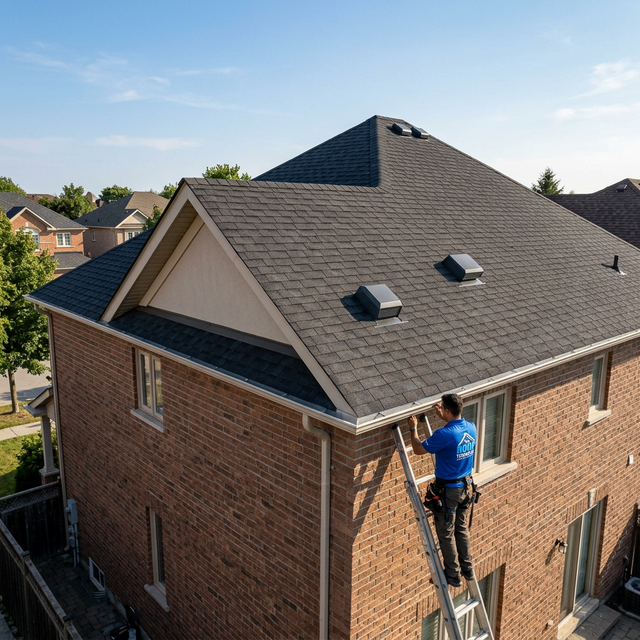
Effective attic ventilation relies on a simple principle: cool air enters through the soffits at the bottom, rises as it warms, and exits through vents at or near the ridge. This is called passive ventilation and it works 24 hours a day without any electricity.
The system works because of two natural forces:
- Stack effect (thermal buoyancy): Hot air is lighter than cold air and naturally rises. In your attic, heated air moves upward and exits through ridge vents or roof vents, pulling fresh air in through the soffits below.
- Wind effect: Wind blowing across the roof creates pressure differences that help pull air out of exhaust vents and push fresh air in through intake vents.
For this system to work properly, you need a balanced ratio of intake to exhaust ventilation. The general industry standard is 1 square foot of net free ventilation area for every 150 square feet of attic floor space, with the ventilation split equally between intake and exhaust.
Types of Attic Ventilation for Toronto Homes
| Ventilation Type | Location | Function | Best For |
|---|---|---|---|
| Soffit Vents | Under the eaves | Intake (brings cool air in) | All homes — essential for balanced ventilation |
| Continuous Ridge Vent | Along the roof peak | Exhaust (lets hot air out) | Most residential roofs — best overall exhaust option |
| Box Vents (Static Vents) | Near the roof peak | Exhaust | Older homes, supplemental ventilation |
| Turbine Vents (Whirlybirds) | Near the roof peak | Exhaust (wind-powered) | Windy areas, budget-friendly option |
| Power Vents | Near the roof peak | Exhaust (electric fan) | Homes with severe heat buildup |
| Gable Vents | Gable end walls | Intake or exhaust | Supplemental only — not sufficient alone |
| Solar-Powered Vents | Near the roof peak | Exhaust (solar fan) | Eco-friendly option, no wiring needed |
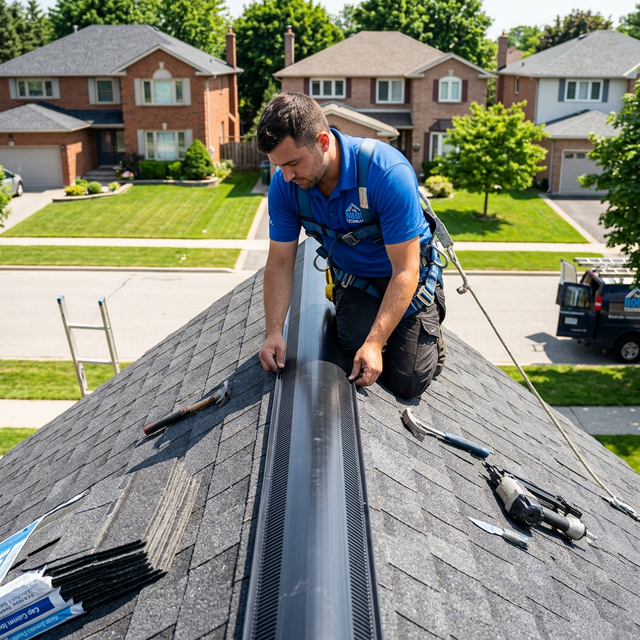
The most effective combination for Toronto homes is continuous soffit vents paired with a continuous ridge vent. This provides uniform airflow across the entire attic space with no dead spots. At The Roof Technician, this is the configuration we recommend and install most often.
7 Warning Signs Your Attic Ventilation Is Failing
Poor attic ventilation rarely announces itself with one dramatic failure. Instead, it causes slow, compounding damage that gets worse over time. Watch for these signs:
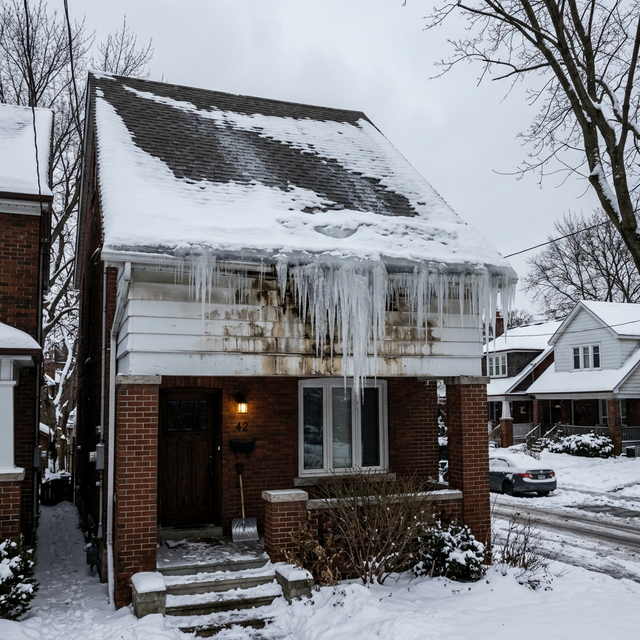
- Ice dams every winter: When heat escapes through an under-ventilated attic, it melts snow on the upper roof. The meltwater refreezes at the cold eaves, forming ice dams that force water under your shingles.
- Shingles curling or aging prematurely: Trapped heat in the attic “cooks” shingles from below, causing them to curl, crack, and lose granules years before they should.
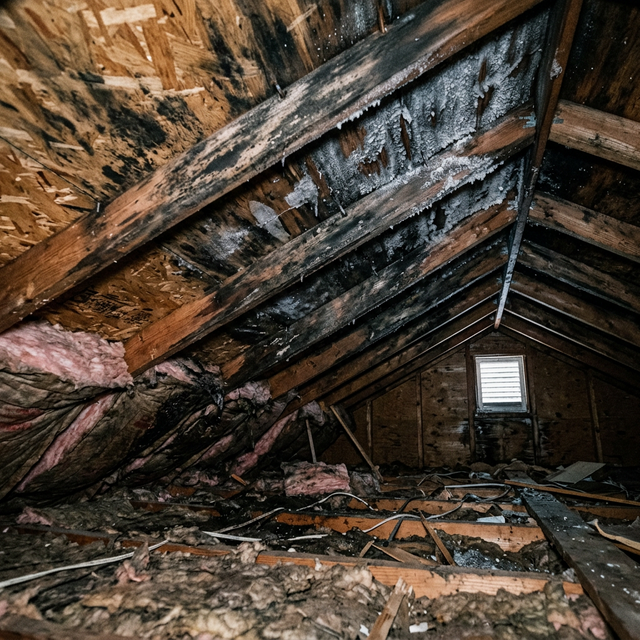
- Mould or mildew in the attic: Warm, moist air from your living space rises into the attic. Without ventilation, that moisture condenses on cold surfaces like rafters and sheathing, creating mould.
- Frost on the underside of the roof deck: In winter, if you see frost or ice crystals inside the attic on the underside of the plywood, moisture is being trapped.
- Excessively hot upstairs rooms in summer: If your second floor is noticeably hotter than the main floor, your attic may be trapping heat that radiates down through the ceiling.
- Peeling paint or wallpaper on upper floors: Excess moisture migrating from the attic can cause paint and wallpaper to bubble and peel on walls and ceilings below.
- Rusty nails or metal fittings in the attic: Condensation from trapped moisture causes metal to rust. If you see rust on nail tips poking through the sheathing, you have a ventilation problem.
The Real Cost of Poor Attic Ventilation
Ignoring ventilation problems leads to expensive consequences that far exceed the cost of fixing the ventilation itself:
| Problem Caused | Typical Repair Cost (Toronto) | How Ventilation Prevents It |
|---|---|---|
| Ice dam damage (interior + roof) | $2,000 – $8,000 | Proper airflow keeps roof surface uniformly cold |
| Premature shingle failure | $8,000 – $15,000 (full replacement) | Removes trapped heat that cooks shingles from below |
| Attic mould remediation | $3,000 – $10,000 | Exhausts moisture before it condenses |
| Roof deck replacement (rot) | $5,000 – $12,000 | Keeps sheathing dry and structurally sound |
| Increased heating and cooling bills | $500 – $1,500/year extra | Balanced airflow reduces HVAC load |
Compare these costs to the price of fixing your ventilation — typically $1,500 to $4,000 — and the math is overwhelmingly clear.
Attic Ventilation and Ice Dams: The Toronto Connection
Ice dams are one of the most common and costly roofing problems in Toronto. Understanding the direct link between attic ventilation and ice dams is essential for every homeowner in our climate.
Here is exactly what happens:
- Heat from your living space (from poor insulation and sealed air leaks) escapes into the attic.
- The warm attic heats the roof deck, which melts snow on the upper portion of the roof.
- The meltwater flows down toward the eaves, which are colder because they extend past the heated house.
- The water refreezes at the eave, forming a ridge of ice (the dam).
- More meltwater backs up behind the ice dam, seeping under shingles and into the home.
The solution is twofold: adequate insulation to stop heat from entering the attic in the first place, and proper ventilation to flush out any heat that does get in. Together, they keep the entire roof surface uniformly cold so snow does not melt unevenly.
What Proper Attic Ventilation Costs in Toronto
| Ventilation Improvement | Cost Range (Toronto) | Description |
|---|---|---|
| Add soffit vents (per vent) | $50 – $100 | Cut and install individual soffit intake vents |
| Continuous soffit strip vents | $500 – $1,500 | Replace solid soffits with vented aluminum strips |
| Ridge vent installation | $800 – $2,000 | Cut ridge and install continuous ridge vent with cap shingles |
| Box vent installation (each) | $150 – $300 | Cut and install static roof vents |
| Power vent installation | $500 – $1,200 | Electric or solar-powered exhaust fan |
| Baffle installation (per rafter bay) | $10 – $25 | Styrofoam baffles to keep insulation from blocking soffits |
| Complete ventilation overhaul | $1,500 – $4,000 | Full soffit venting, ridge vent, baffles, and airflow optimization |
When paired with a roof replacement, adding proper ventilation is significantly cheaper because the roof is already open. This is the ideal time to upgrade your ventilation system.
How to Check Your Attic Ventilation (DIY Inspection)
You can do a basic check yourself before calling a professional:
- Go into your attic on a hot summer day: If the temperature is dramatically hotter than outside (over 60°C), your ventilation is inadequate.
- Look for daylight at the eaves: You should see light coming in through the soffit vents. If soffits are solid with no vents, you have zero intake airflow.
- Check the insulation near the eaves: If insulation is pushed up against the roof sheathing and blocking the soffits, air cannot enter even if vents are present.
- Look for moisture signs: Condensation, frost, dark staining on wood, mould spots, or rust on nails are all red flags.
- Check from outside: Look at the roof. Do you see ridge vents, box vents, or turbines near the peak? If the only vents are gable vents on the end walls, your exhaust is likely insufficient.
For a thorough assessment, schedule a professional inspection with The Roof Technician. We check airflow balance, insulation interference, and moisture levels to give you a complete picture.
Common Attic Ventilation Mistakes
Even well-intentioned homeowners and contractors make ventilation mistakes that reduce effectiveness or create new problems:
- Mixing exhaust vent types: Using both a ridge vent and power vent together can cause them to short-circuit each other. The power vent pulls air from the nearby ridge vent instead of from the soffits.
- Insulation blocking soffit vents: Blown-in insulation frequently covers the intake vents at the eaves. Without baffles, even vented soffits become useless.
- Sealing the attic too tightly: While air-sealing the living space ceiling is essential, sealing the attic itself prevents airflow. The attic should be ventilated, not conditioned.
- Too much exhaust, not enough intake: If exhaust capacity exceeds intake, the system draws air from gaps in the building envelope (around light fixtures, plumbing stacks) instead of through the soffits, pulling conditioned air out of your home.
How do I know if my attic has proper ventilation?
Does attic ventilation help prevent ice dams in Toronto?
How much does it cost to improve attic ventilation?
Can poor ventilation void my roof warranty?
What is the best type of attic ventilation for Toronto homes?
Should I add attic ventilation during a roof replacement?
Book Your Free Attic Ventilation Assessment
If you are noticing any of the warning signs above — ice dams, hot upper floors, attic moisture, or premature shingle aging — your ventilation likely needs attention. The good news is that fixing it is straightforward and cost-effective.
Call The Roof Technician today at (416) 826-0040 or request a free consultation to have our experienced team inspect your attic ventilation and recommend the right solution for your home.
The Roof Technician provides expert attic ventilation upgrades and roof repair services throughout Toronto, Mississauga, Brampton, Oakville, Vaughan, Markham, and the entire Greater Toronto Area.