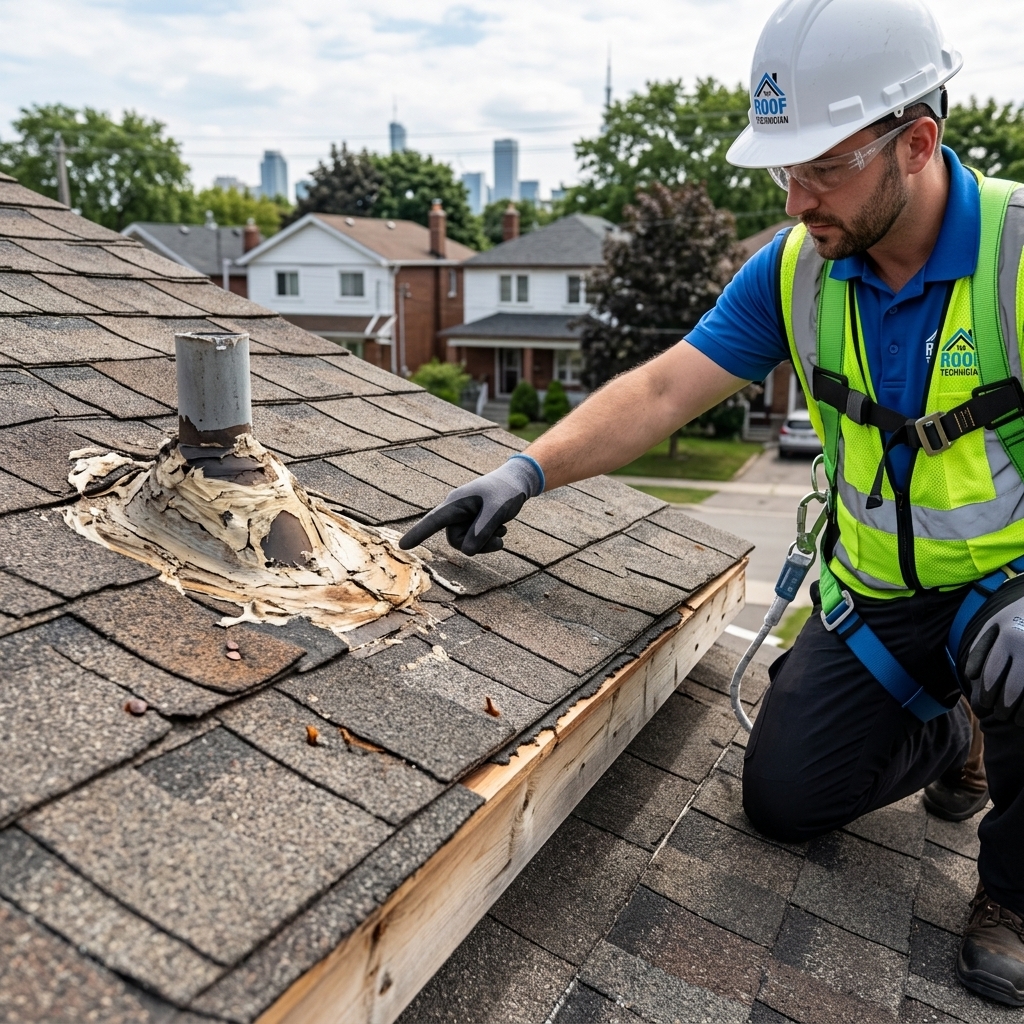
Hiring the wrong roofing contractor is one of the most expensive mistakes a Toronto homeowner can make. A poorly executed roofing job does not just look bad — it creates hidden water intrusion pathways, compromises the structural integrity of the roof deck, voids manufacturer warranties, and can cost $10,000-$30,000+ in corrective repairs that should never have been necessary. The Roof Technician regularly inspects roofs across Toronto where homeowners suspect substandard work — and the warning signs of a bad roofing job follow remarkably consistent patterns. This guide teaches Toronto homeowners exactly what to look for to identify a bad roofing job, how to inspect your roof after a contractor completes work, what red flags to watch for during the hiring process, and what recourse you have if you discover shoddy workmanship on your Toronto home.
Warning Signs of a Bad Roofing Job on Your Toronto Home
The following defects are the most common indicators of a bad roofing job that The Roof Technician identifies during post-installation inspections in Toronto. Any of these issues individually is cause for concern — multiple issues together indicate systemic poor workmanship that may require significant corrective work.
| Warning Sign | What It Looks Like | Why It Is Dangerous | Corrective Cost |
|---|---|---|---|
| Crooked or uneven shingle lines | Shingle rows visibly wavy, not straight when viewed from ground | Indicates no chalk lines used — misaligned shingles expose nail heads and create water pathways | $3,000-$15,000+ |
| Exposed or overdriven nails | Nail heads visible on shingle surface or shingles dimpled around nails | Exposed nails are direct water entry points; overdriven nails crack shingle and lose holding power | $1,000-$5,000 |
| Missing or insufficient flashing | Caulk or tar used where metal flashing should be (walls, chimneys, valleys) | Caulk fails within 2-5 years — proper metal flashing lasts the life of the roof | $2,000-$8,000 |
| No drip edge installed | Shingles extend over fascia with no metal edge underneath | Water wicks under shingles and rots fascia board — Ontario Building Code requires drip edge | $1,500-$4,000 |
| Shingle overhang too long or short | Shingles extending more than 1.5 inches past drip edge or not reaching it | Too long causes wind uplift; too short allows water behind the drip edge | $2,000-$8,000 |
| Improper valley treatment | Shingles woven across valley instead of cut valley or open metal valley | Woven valleys dam water and debris, leading to premature failure in the highest-flow area of the roof | $1,500-$5,000 |
| No ice and water shield | Only felt underlayment at eaves, valleys, and penetrations | Ontario Building Code requires ice and water shield at eaves in the Toronto climate zone | $2,000-$6,000 |
| Old flashing reused | New shingles installed around existing chimney, pipe, and wall flashings | Old flashing has degraded — reusing it creates leak points within 2-5 years under new shingles | $1,000-$4,000 |
| Inadequate ventilation | No ridge vent, blocked soffit vents, insufficient exhaust | Causes ice dams, shingle blistering, and voided manufacturer warranty | $1,500-$5,000 |
| No cleanup or leftover debris | Nails in driveway and lawn, old shingles left in yard | Indicates careless workmanship — if visible cleanup is poor, hidden workmanship is likely poor too | $200-$500 |
Red Flags When Hiring a Roofing Contractor in Toronto
The best way to avoid a bad roofing job is to hire the right contractor from the start. The following red flags during the hiring and quoting process are strong predictors of substandard work.
- Door-to-door solicitation after storms: Legitimate roofing contractors in Toronto do not go door-to-door after storms. This is a common tactic used by storm chasers — unlicensed, uninsured operators who follow storm paths, collect deposits, deliver poor quality work, and disappear before warranty claims arise
- Verbal-only quotes: Any reputable roofer provides a detailed written estimate itemizing scope of work, materials (brand and product line), labour, waste removal, and warranty terms. Verbal quotes provide no accountability and no recourse if the work is substandard
- No WSIB coverage: Ontario requires roofing companies to carry Workplace Safety and Insurance Board coverage. Without WSIB, the homeowner is financially liable if a worker is injured on their property. Always verify WSIB clearance certificates before signing any contract
- No liability insurance: A minimum of $2 million in commercial general liability insurance should be verified. Request a certificate of insurance naming your property address — not just a policy number
- Demands full payment upfront: Standard practice in Toronto is a deposit (10-25%) to secure materials, with the balance due upon satisfactory completion. Any contractor demanding full payment before work begins is a significant risk
- Significantly lower price than competitors: If one quote is 30-50% lower than three other reputable quotes, the low bidder is likely cutting corners — using cheaper materials, skipping ice and water shield, reusing old flashing, or not carrying proper insurance
- No references or portfolio: Established roofing contractors have extensive portfolios of completed work and can provide references from recent Toronto projects. Reluctance to provide references is a red flag
- Lack of manufacturer certification: Major shingle manufacturers (GAF, CertainTeed, IKO, BP) offer contractor certification programs that require demonstrated installation quality. Certified contractors can offer enhanced warranties. Non-certified installers may void the shingle manufacturer’s warranty through improper installation
How to Inspect a Completed Roofing Job
Every Toronto homeowner should conduct a thorough inspection (or hire an independent inspector) after a roofing job is completed and before making final payment. The Roof Technician offers post-installation inspection services for homeowners who want independent verification of contractor workmanship.
Ground-Level Inspection Checklist
- Shingle lines appear straight and uniform from ground level
- Drip edge is visible and extends beyond the fascia board
- Ridge cap shingles are installed straight and uniform along the ridge
- No exposed nails visible from ground level
- Valleys appear clean and properly finished
- No sagging or dipping in the roof plane
- All debris, old shingles, and nails have been cleaned from the property
- Gutters are clean and properly reattached
Close-Up Inspection Checklist (Ladder or Roof Level)
- Ice and water shield visible at eaves (minimum 3 feet from edge in Toronto climate zone)
- Metal flashing at all wall-to-roof transitions, chimneys, and pipe penetrations
- Proper nail placement — nails in the designated nail zone, not above or below
- Ridge vent installed with proper baffles and shingle cap
- Starter strip installed along all eaves and rakes
- All pipe boots are new rubber (not reused old boots)
- Step flashing woven properly with shingle courses at walls
What to Do If You Discover a Bad Roofing Job
If you discover indicators of a bad roofing job on your Toronto home, take these steps immediately.
- Document everything: Photograph all defects from multiple angles. Take wide shots showing context and close-ups showing specific problems. Date your photos
- Get an independent inspection: Hire a different roofing company (like The Roof Technician) to perform a professional inspection and provide a written report detailing all defects found. This independent documentation is essential for any dispute resolution
- Contact the original contractor in writing: Send a formal written notice (email with delivery confirmation or registered mail) listing every defect and requesting corrective work within a specific timeframe (typically 14-30 days). Reference the contract terms and warranty obligations
- File a complaint with consumer protection agencies: If the contractor refuses to address legitimate defects, file complaints with the Better Business Bureau, Ontario Ministry of Government and Consumer Services, and your local municipal licensing authority
- Consult a construction lawyer: For significant defect claims ($10,000+), a construction lawyer can advise on Ontario’s Construction Act provisions, lien rights, and small claims or Superior Court options
Cost of Correcting Bad Roofing Work in Toronto
| Corrective Work | Cost | What Is Involved |
|---|---|---|
| Flashing replacement (all penetrations) | $2,000-$8,000 | Remove shingles around flashings, install proper step/counter flashing, reinstall shingles |
| Drip edge installation (entire perimeter) | $1,500-$4,000 | Lift edge shingles, install drip edge, reseal |
| Partial re-shingling (one slope) | $3,000-$10,000 | Strip and redo one slope with proper materials and technique |
| Full corrective re-roofing | $10,000-$30,000+ | Strip entire roof, install proper underlayment, ice shield, flashings, and shingles correctly |
| Ventilation correction | $1,500-$5,000 | Add ridge vent, clear blocked soffit vents, add exhaust capacity |
Warranty Protection and Your Roofing Investment
A properly executed roofing job in Toronto should come with two layers of warranty protection: the manufacturer’s material warranty and the contractor’s workmanship warranty. Understanding how a bad roofing job can void both warranties — leaving you completely unprotected — is essential for every Toronto homeowner.
Manufacturer warranties (GAF, CertainTeed, IKO, BP) cover material defects — premature granule loss, cracking, delamination — but only when the shingles are installed according to the manufacturer’s specific installation instructions. Common installation defects that void manufacturer warranties include: improper nail placement (high nailing, which is above the nail line), insufficient number of nails per shingle (most manufacturers require 4-6 nails depending on wind zone), inadequate attic ventilation (manufacturers require a minimum balanced ventilation ratio), and missing components such as starter strip, ice and water shield, and drip edge. A bad roofing job that cuts these corners to save time or material cost leaves the homeowner with zero manufacturer warranty protection — meaning if the shingles fail prematurely, the homeowner bears 100% of the replacement cost. Contractor workmanship warranties typically cover 5-10 years of labour for installation defects. However, if the contractor who performed the bad roofing job is unlicensed, uninsured, or a fly-by-night storm chaser, the workmanship warranty is worthless because the contractor cannot be located or has no assets to satisfy a claim. The Roof Technician provides comprehensive 10-year workmanship warranties backed by our established Toronto business — and our certified installer status ensures full manufacturer warranty protection on every roof replacement we complete.
Toronto homeowners should also be aware that the City of Toronto’s Consumer Protection office maintains records of complaints against roofing contractors. Before hiring any roofer, check the contractor’s Better Business Bureau rating, verify their Google Reviews profile for consistent positive feedback, and request proof of both WSIB coverage and commercial general liability insurance. A reputable contractor providing quality roofing work will readily supply all documentation without hesitation.
How do I know if I have a bad roofing job?
What is the most common roofing installation mistake?
How much does it cost to fix a bad roofing job in Toronto?
Should I hire a different roofer to fix the problems?
Does a bad roofing job void my shingle warranty?
What should I check before paying a roofing contractor?
Concerned About Your Roof? Call The Roof Technician
If you suspect a bad roofing job on your Toronto home, The Roof Technician provides independent professional inspections, detailed defect reports, and expert corrective roof repair services across Toronto and the GTA.
Call (416) 826-0040 or request an inspection for peace of mind.
The Roof Technician — Toronto’s trusted roofing contractor for roof replacement, roof repair, flat roofing, and independent roof inspections across Toronto, Mississauga, Brampton, Oakville, Vaughan, Markham, and the full GTA.